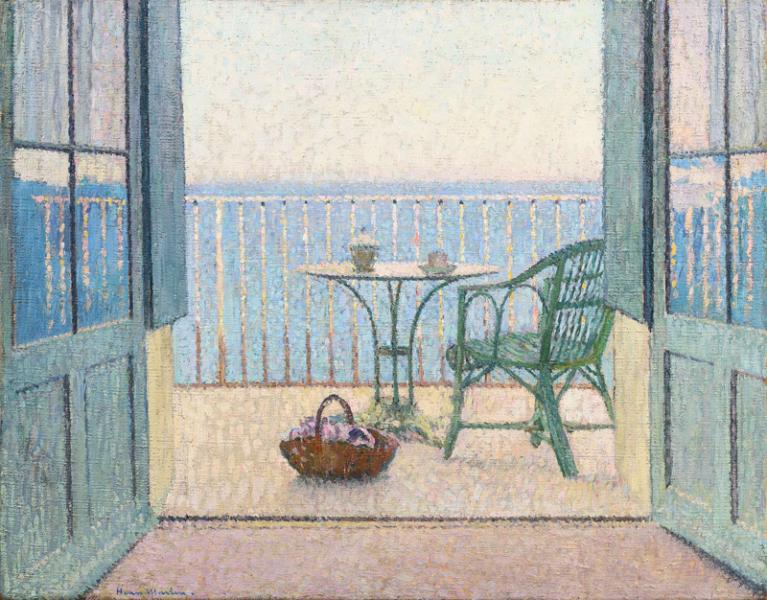
Terrasse devant la mer, circa 1930
Oil on canvas, signed lower left.
73 x 92.50 cm
Provenance:
Estate of Cyrille Martin
Exhibitions:
Derniers impressionnistes, Le temps de l’intimité, Musée de Lodève, 26 September 2020 – 28 February 2021, reproduced in the exhibition catalogue, p. 271.
Henri Le Sidaner – Henri Martin, travelling exhibition in Japan:
Hiroshima Museum of Art, Hiroshima, 11 September – 24 October 2021; Yamanashi Prefectural Museum of Art, Kofu, 3 November 2021 – 10 January 2022; Sompo Museum of Art, Tokyo, 26 March – 26 June 2022; Kagoshima City Museum of Art, Kagoshima, 15 July – 31 August 2022; Museum EKI Kyoto, Kyoto, 10 September – 6 November 2022;
Okada Cultural Foundation – Paramita Museum, Mie, 3 December 2022 – 29 January 2023.
Inaugural exhibition at the Pavillon de la Reine Jeanne, Galerie Alexis Pentcheff, Marseille, 3 October – 15 November 2023, reproduced in the exhibition catalogue, p. 65, no. 10.
Henri Martin – Henri Le Sidaner, Deux talents fraternels, Palais Lumière, Évian, 8 June 2024 – 5 January 2025; Singer Museum, Laren, 22 January – 11 May 2025, reproduced in the catalogue (ed. Monelle Hayot), p. 244.
Opinion confirming inclusion in the archives intended for the preparation of the artist’s catalogue raisonné, currently in preparation by Mrs Marie- Anne Destrebecq-Martin.
On the terrace, an empty armchair contemplates the horizon. A cup and a sugar bowl on the table seem to await the return of the one (or rather the other, if we consider the basket of skeins on the floor) who has just crossed the threshold to enter the coolness of the house for a moment.
We savor the silence of this suspended moment.
As a master of composition, Henri Martin has perfectly orchestrated the scene's shift from inside to outside. The threshold is materialized by a horizontal line, and all we have to do is step over it to embrace this new space, this other perspective, to breathe in the fresh air, drawn outwards on all sides, not only by the gap in our field of vision, but also by the reflections of the French windows, both left and right.
Horizontal and vertical lines clash, resolving themselves in a luminous escape. The horizon line, just above the barrier, seems to mark the boundary between sky and water, yet there is nothing in the landscape to help us situate ourselves, leaving us free to interpret and remember.
Are we facing the Mediterranean on this terrace where Penelope has set down her work for a moment? Are we in Marseille or Collioure?
The only clues given by the painter are a few architectural elements: the French window and its shutter sized to the squares, and the railing.
A closer look at the seaside resorts the artist frequented reveals that the inspiration for this type of décor came from Collioure, with its simple vertical railing motif typical of the fishermen's houses in the little port. In 1923, Henri Martin bought a house in Collioure, which his youthful friend Henri Marre had introduced him to.
He stayed there every summer until the outbreak of war, also renting a studio on the port. In July, he left Labastide to head a little further south, to the little haven that the Fauves had adopted. As for the other elements of the composition: the table, the chair and the basket, a priori they belong to Marquayrol's universe. They are identical, notably in Henri Martin's well-known painting Les Tricoteuses (recently deposited at the Musée des Beaux-Arts de Nantes), executed in 1913, explicitly located under the pergola forming the trellis in the property's large garden.
Henri Martin probably composed this terrace, poetic in its expectation, just above the sea. Building his painting on the trace of a presence, the painter here abstracts himself from any human figure. The absence, made palpable by the objects: the basket, the cup, the chair, is tinged with a gentle melancholy echoed by the painting's rather coolly luminous palette. Fresh blues, greens, whites, pinks and butters dominate.
The terrace overlooking the sea, and the rattan swirls of his neglected chair, take on a meditative dimension. Henri Martin, in the end, remained a symbolist.